Words by: Daantjie Botha
The 2025 Region 5 All Species Tournament took place at Mapunga Bush Camp on the banks of the upper Kafue River in Zambia from 25–29 August. Four nations participated—South Africa, Zambia, Zimbabwe, and Namibia—with a total of 27 teams and 80 anglers competing across the divisions.
The South African Artificial Lure Angling Association (SAALAA) received approval from the South African Sport Anglers & Casting Confederation (SASACC) to adapt to the rules of the Region 5 competition, ensuring that South African Artlure is represented at this annual event. Without this approval, our Protea artlure teams would have had very limited international opportunities, given the niche role artlure plays within the broader South African angling community.
Through SASACC, SAALAA is also affiliated with FIPSed, the global governing body for competitive angling, under whose rules our Protea artlure teams continue to compete at the World Championships. The ability to participate in both Region 5 competitions and FIPSed World Championships opens the door to greater opportunities for South African anglers—both internationally and across the African continent.
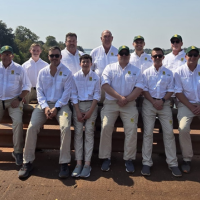
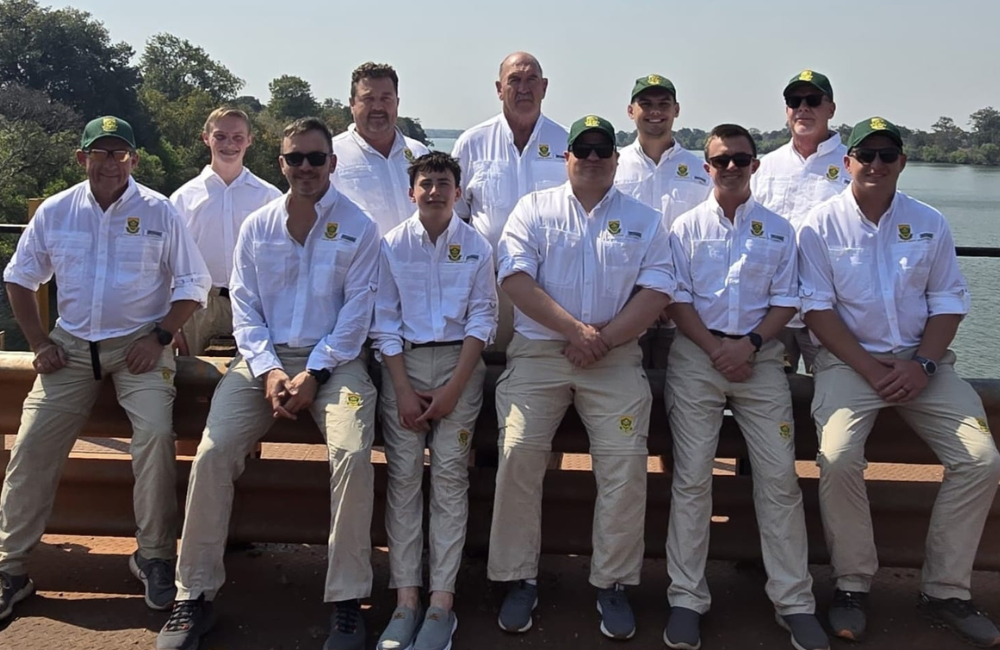
The Protea squad featured a senior team of four pairs, captained by veteran angler Emile van Druten. His teammates were Francois Joubert, Derek Nell (Angler/Travelling Manager), Damon Nell, Theuns Brecher, Daantjie Botha, Henry Fourie, and Steven Wright. A strong junior side was also fielded, consisting of Emile van Druten Jnr, Tiano Alberts, and Josh Stobbart, under the guidance of skipper Byron Stobbart. Back home, SAALAA Chairperson Sampie Britz coordinated logistics as the South African-based team manager.
On Thursday, 21 August, the team departed Pretoria on a three-day, 2,000 km journey across Botswana and Zambia. They linked up with members who had flown into Lusaka and all arrived at Mapunga Bush Camp by Sunday, 24 August. Nestled within Kafue National Park, the camp offers a true African wilderness experience: elephants and hippos roam through the site, while the distant roar of lions echoes at night. Facilities, though simple, were spotless and well maintained, with ample camping, clean ablutions with hot water, and a welcoming dining area where all teams shared breakfast and dinner daily.
Practice days on 25 and 26 August saw anglers covering almost 70 km of river, both upstream and downstream, to locate fish species and refine techniques. For the Proteas, this posed a fresh challenge, as artlure angling in South Africa is mostly practiced on smaller dams.
The competition officially ran from 27–29 August. Rules allowed for 13 eligible fish species, each with a minimum size requirement. Over the three days, teams could record 15–20 specimens per species to complete their full bag.
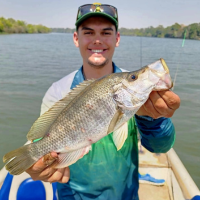
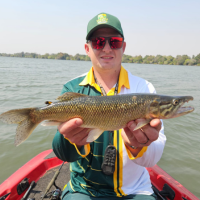
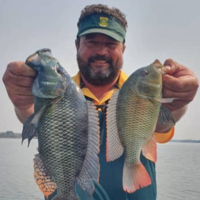
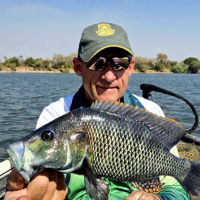
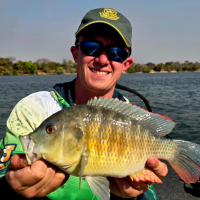
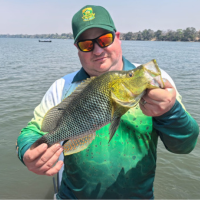
The Proteas, specialists in lure fishing, excelled particularly with largemouth bream species such as Humpback, Thinface, Purpleface, and Brownspot bream. They also enjoyed success with smaller species like Redbreast Kurper, Greenhead Kurper, and the colourful Pink, Green, and Rainbow Happies. Productive lures included Salmo Hornets (3.5–4.5 cm in gold and purple) and Rapala X-Light Micro Cranks (silver and gold) for largemouths, while smaller 2 cm Hornets and curly-tail worms proved effective on the smaller species. The traditional Engelbrecht “tiekie” spinner tipped with earthworm—a classic technique from Lake Kariba—also produced excellent results.
The largemouth bream typically held around drop-offs near isolated grass patches in 2–3 metres of water. In contrast, smallmouth bream were often tightly grouped inside shallow grass beds less than a metre deep. Light conditions also played a role: during early mornings and late afternoons, the sun’s angle generated extra flash from the blades of the Engelbrecht spinners, consistently triggering strikes from larger fish.
Other species proved more difficult. Silver catfish (makriel), usually found in large schools, were scattered and quick to disperse once located. A variety of spinner lures—including Molix Tail Spins, Duo Realis Tail Spinners, Mepps, and Effzett inline spinners—proved useful when opportunities arose. The tail spins were especially effective in deeper water (2.5 m+) with slower flow, where their fast sink rate allowed anglers to get lures down quickly. By contrast, the Mepps and Effzett inline spinners were ideal for covering large areas efficiently, serving as excellent scouting or “power fishing” tools to locate active fish.
African pike were also reluctant, their feeding hampered by unusually stained water that limited their sight-based hunting. Most of the pike landed were opportunistic strikes, with the above-mentioned lures drawing bites when brought within striking distance.
Barbel were abundant but generally undersized. Larger specimens, however, responded well to bright Big Cat Poppers on the lure side and to chicken hearts on the bait side.
The junior Protea team was outstanding. Skipper Byron Stobbart devised a clever strategy that played to each angler’s strengths:
- Emile van Druten Jnr – power fishing with lures for big predators
- Tiano Alberts – finesse micro-fishing for smallmouth species
- Josh Stobbart – a versatile role, adapting between the two
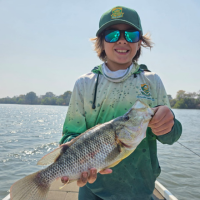
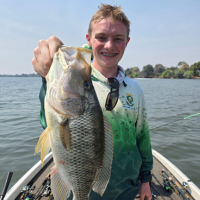
Supported by expert use of forward- and side-scan sonar, the juniors consistently stayed on the fish. Their reward was nothing short of remarkable: Gold in the junior division for South Africa, along with triple gold medals for the largest Largemouth Bream, Smallmouth Bream, and African Pike. None of the juniors had fished these waters before, yet they outperformed most senior and ladies’ teams across all four nations—a historic moment for South African artlure.
The senior team faced a tougher task. Competing against experienced local anglers on unfamiliar waters, and with fewer team members than other nations, podium finishes were always going to be a challenge. Still, the Proteas finished 4th overall—their highest points tally ever at a Region 5 event. In fact, on a per-team basis, their average points exceeded those of Namibia, who claimed bronze. Another highlight was that the average size of fish caught by the Protea seniors was among the largest in the tournament, showing that bigger specimens are often more inclined to strike lures than bait.
Importantly, the tournament also drew strong participation from ladies’ teams representing the different nations. Their presence added an exciting dynamic and showcased the growing inclusivity of competitive angling in the region. We believe this momentum will inspire and open the door for more South African ladies to take part at international level in the years ahead.
The event concluded with a festive closing ceremony and prize-giving on 29 August. The South African team began their long journey home the following morning, returning with new friendships, unforgettable memories, and many personal-best catches ticked off the bucket list. The Zambian hosts were exceptionally well-organised and welcoming, ensuring a smooth tournament for all.
With SAALAA now a fully fledged member of the Region 5 competition—and with artlure techniques firmly at the heart of our participation—we look forward to nurturing a new generation of young, exciting talent who will carry South African artlure fishing into the future.
Looking ahead, the 2026 Region 5 All Species Tournament will be hosted by Namibia on the mighty Zambezi River—a once-in-a-lifetime opportunity for anglers fortunate enough to don the green and gold.
View Gallery